|
|
|
|
Company info
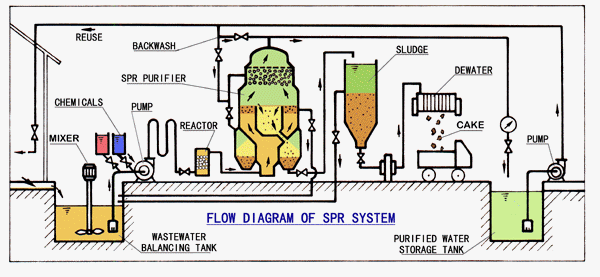
Introduction to SPR Technology The SPR Wastewater Treatment Technology is a company with decades of experience in environmental protection, scientific research and wastewater treatment engineering. The SPR Wastewater Treatment System combines scientific principles of chemistry, physics, and hydromechanics to form its unique and patented technology. The scientific data of SPR serial products has met and/or surpassed international standards (see attached data). SPR's products can treat industrial wastewater and urban sewage with a high concentration of organic pollutants (CODcr: 1000mg/l) and a high degree of suspended solids (SS > 500mg/1- 5000mg/1). In comparison to conventional wastewater treatment the SPR system is significantly more effective and energy and cost efficient.
While the raw water is being fed into the treatment tank, the SPR system adds chemicals to separate the organic pollutants from the water and then coagulate them. The hydromechanically designed water then begins to rotate at a calculated rate to remove these flocculi of pollutants. The sludge is collected in the center and the purified water flows out of the top of the tank. All water purification steps (coagulation, defecation, filtration and sludge concentration) are contained in the tank and the entire process takes just about 30 minutes much faster than conventional water purification method. Our data shows that the purified water contains CODcr <100mg/l and SS <3mg/l, and has the elimination rate of organic pollutants > 82%-90%; suspended solids >99.5%; and colorant >98%. In ceramic and porcelain factories, the discharged sludge reaches the moisture rate of <90% (china clay), which surpasses the current international level. In addition, the sludge can be easily dried to produce byproducts, such as mud bricks (as shown in picture). The purified water can also be recycled for re-production, thereby saving precious water resources, cutting costs of production, and protecting and improving our living environment.
SPR Technology 2000. |